Intelligence
Deterministic sufficiency, bounded specialists and model routing. Advice only—never tool, approval or promotion authority.
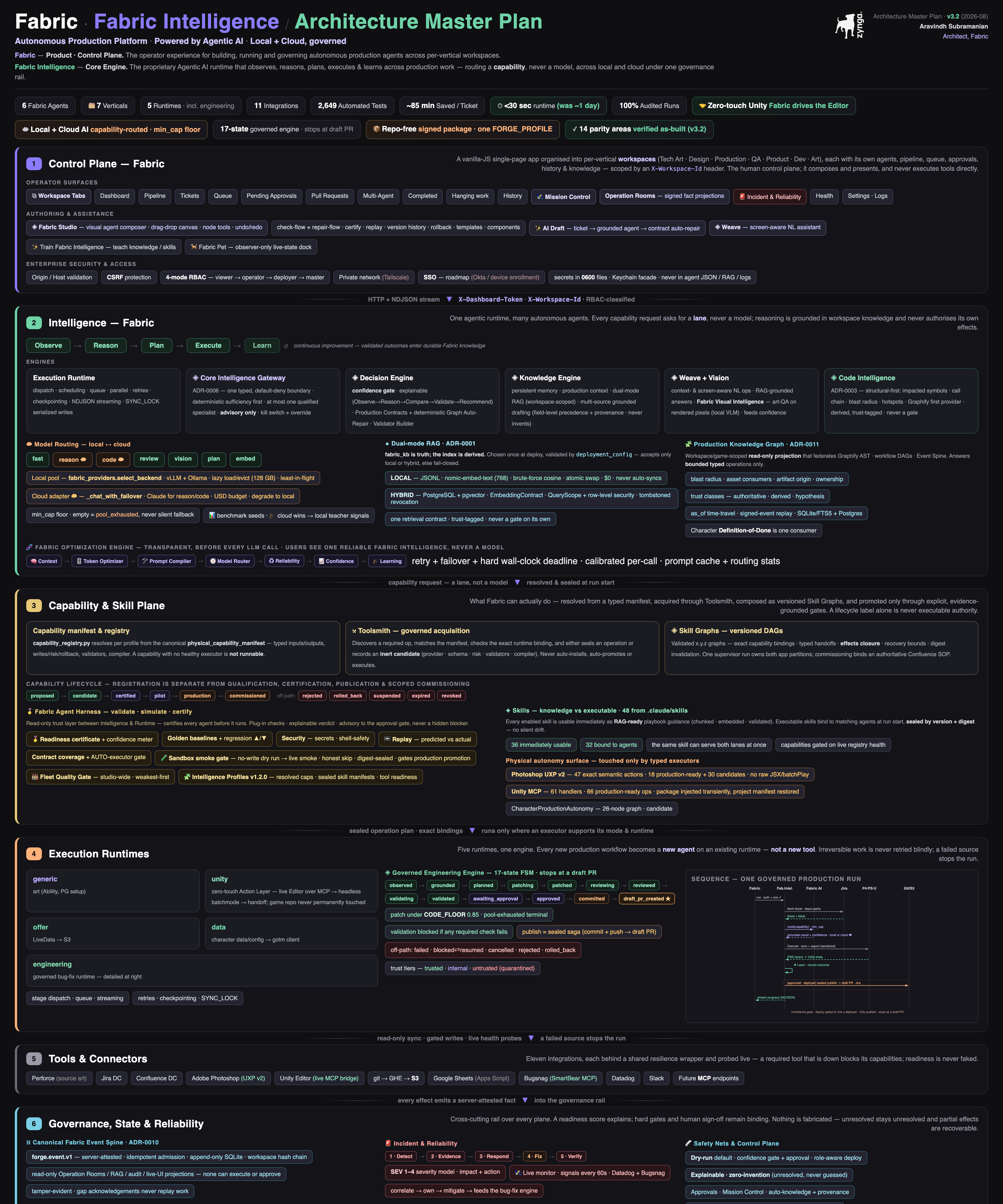
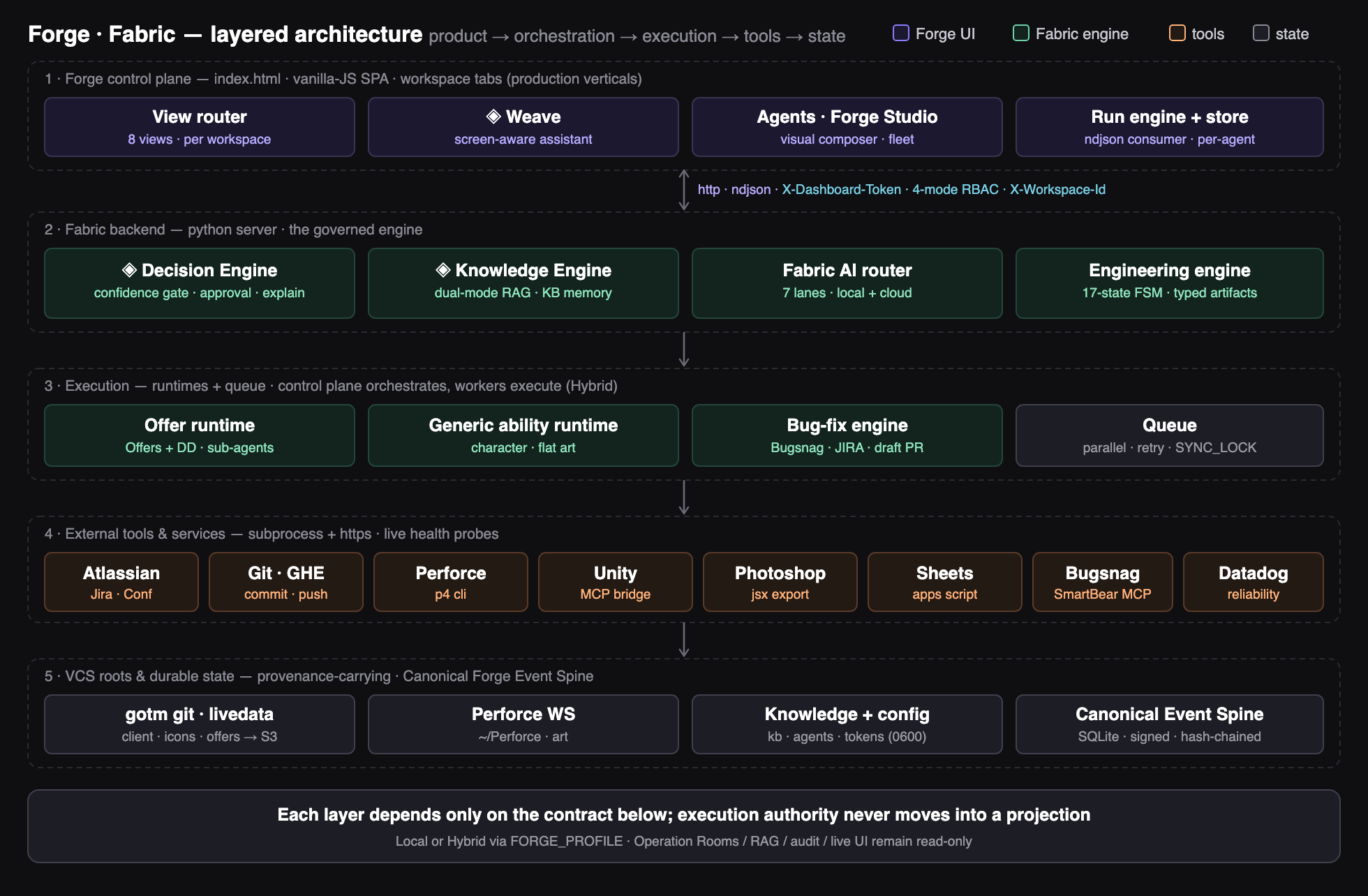
Fabric is a layered system. Each layer has a single responsibility, a stable contract to the layer above, and a clear boundary it will not cross. Models sit at the core and are replaceable; the human control plane sits at the top.
Explore
Authority map
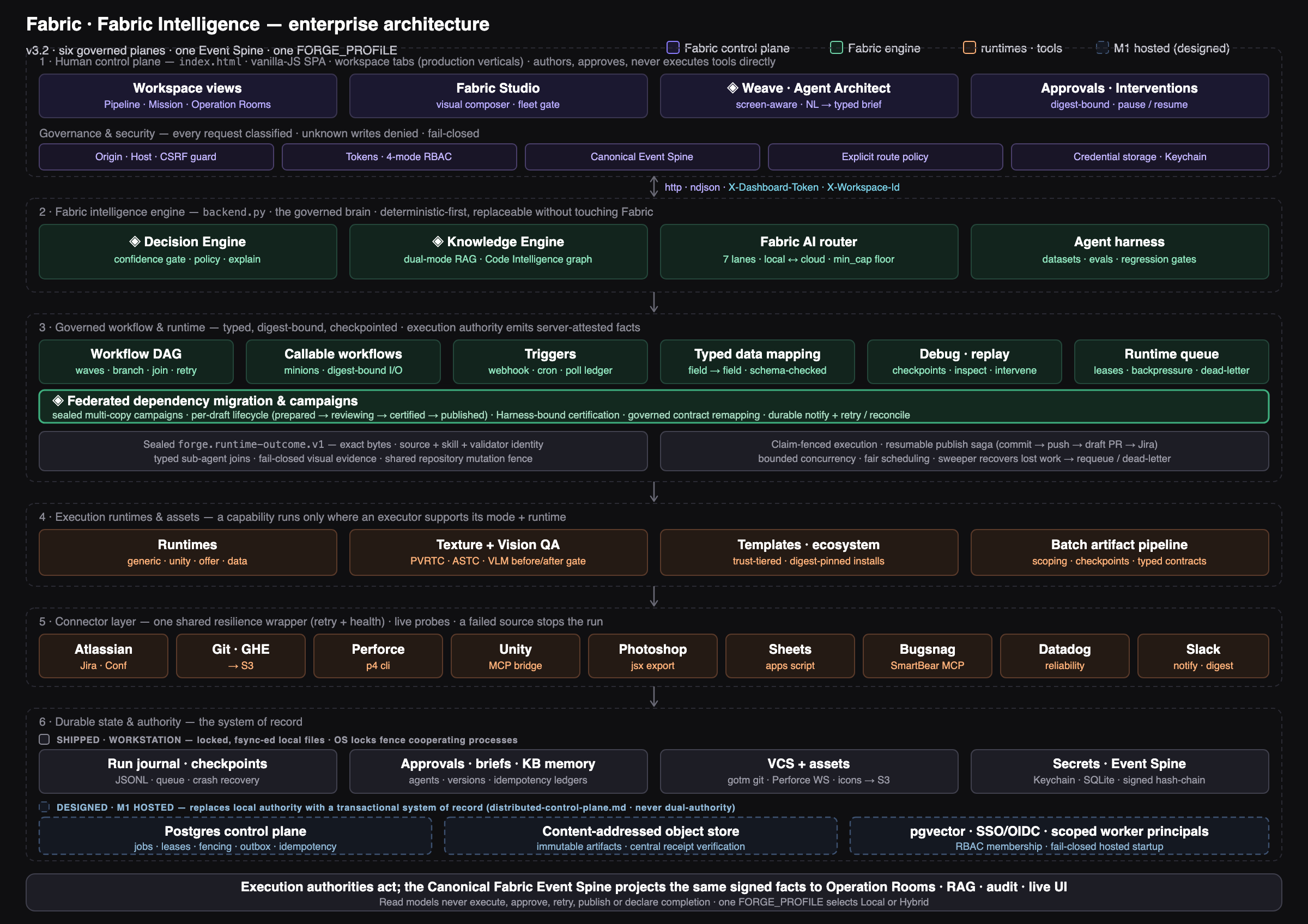
The canonical logical map is Intelligence → Context & Knowledge → Capability → Execution → Governance → Assurance. These are ownership boundaries, not hosts: Local may run all six together and Hybrid may split them, but no plane may manufacture another plane's authority.
Deterministic sufficiency, bounded specialists and model routing. Advice only—never tool, approval or promotion authority.
Digest-bound Context Envelope, model-aware budgets, World State v2, compatibility evidence, RAG and provenance. Retrieved content is untrusted evidence; the index is derived.
Typed registry, executable skills, Skill Graphs and provider bindings. Discovery or handler presence never proves qualification.
Workflow, state-aware replan, durable jobs, dispatch and reconciliation. Unknown completion stops; it is not retried or called rollback.
Identity, consent, approvals, claims, commissions and scoped Secret Broker references. Caller self-assertions grant nothing.
Evidence-derived confidence, validators, shared contracts, emergency stop and independent attestations. It can stop every plane, not authorize one.
92 skills: 55 executable and 37 activation-contract gated. The physical manifest contains 143 Photoshop/Unity operations, with two unsafe unbounded Unity proposals retired. The shared registry holds 30 contracts and 3 deprecations. Context budgeting/diff, World State v2 and compatibility, evidence-derived confidence, normalized Agent/Capability projections, sealed checkpoints and the execution-event read model are repository foundations, not production qualification. All seven RAG workspaces completed a verified post-recommission refresh; later canonical changes deliberately make the derived indexes stale until the next source freeze and refresh. Default was recommissioned at a clean Event Spine boundary; the prior signed chain is retained read-only under a checksum manifest, zero ambiguous Default facts were migrated, and every non-Default signed row was preserved exactly. Protected Google Sheets and the remaining Atlassian Cloud source remain explicit degraded collectors until access or retirement is owner-approved. The specialist-preview host producer registers exact source bindings, while future producers must use the same boundary. The bounded 2D Iconic Item Unity apply adapter now retains a separately operated, pinned-key Ed25519 qualification attestation; agent release and outward effects remain independently gated. Full ownership and gate map →
The stack
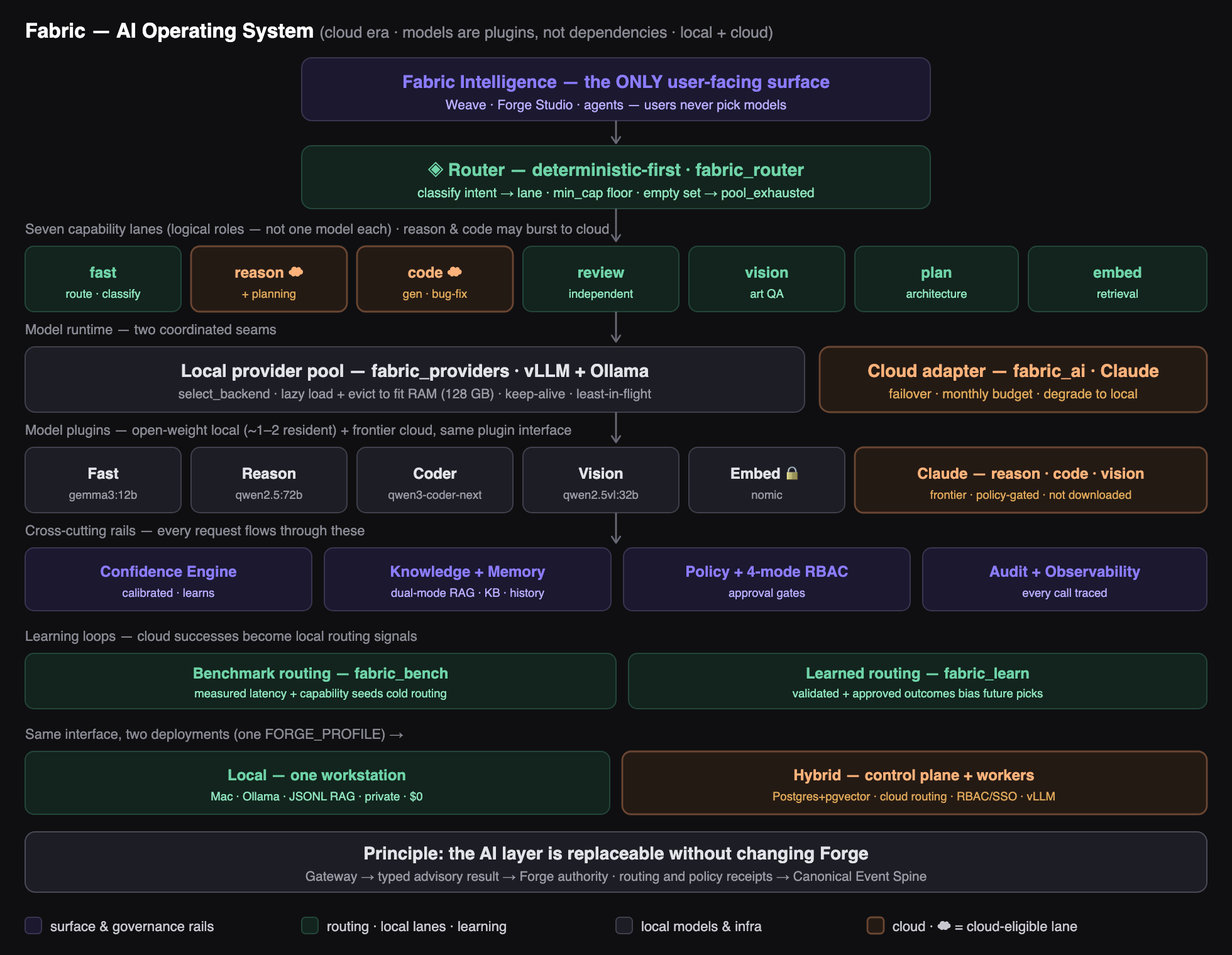
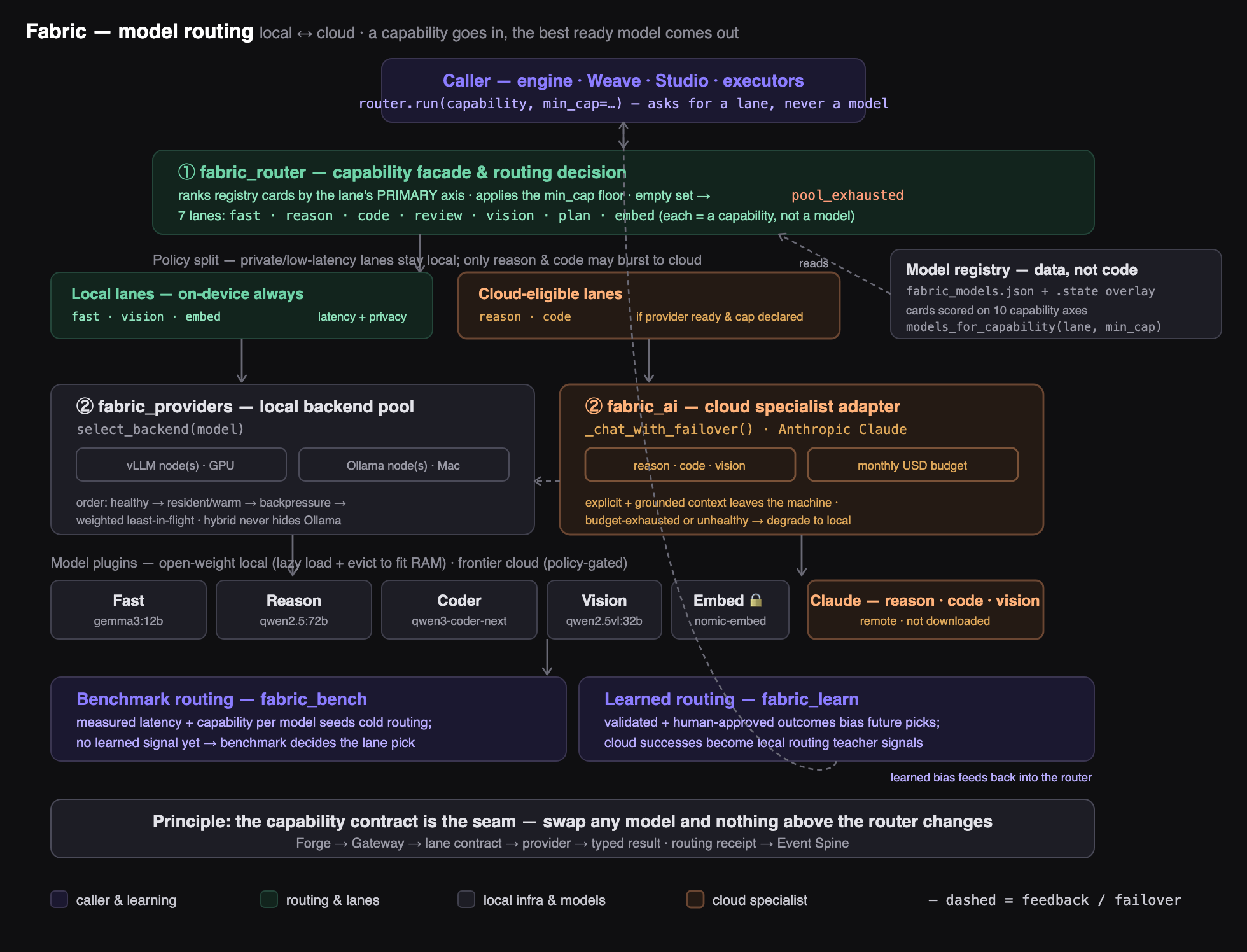
Open-weight local models and a cloud specialist behind a capability contract — seven lanes (fast · reason · code · review · vision · plan · embed) routed with a competence floor; only reason and code may burst to cloud.
Boundary: replaceable — swap a model and nothing above changes.
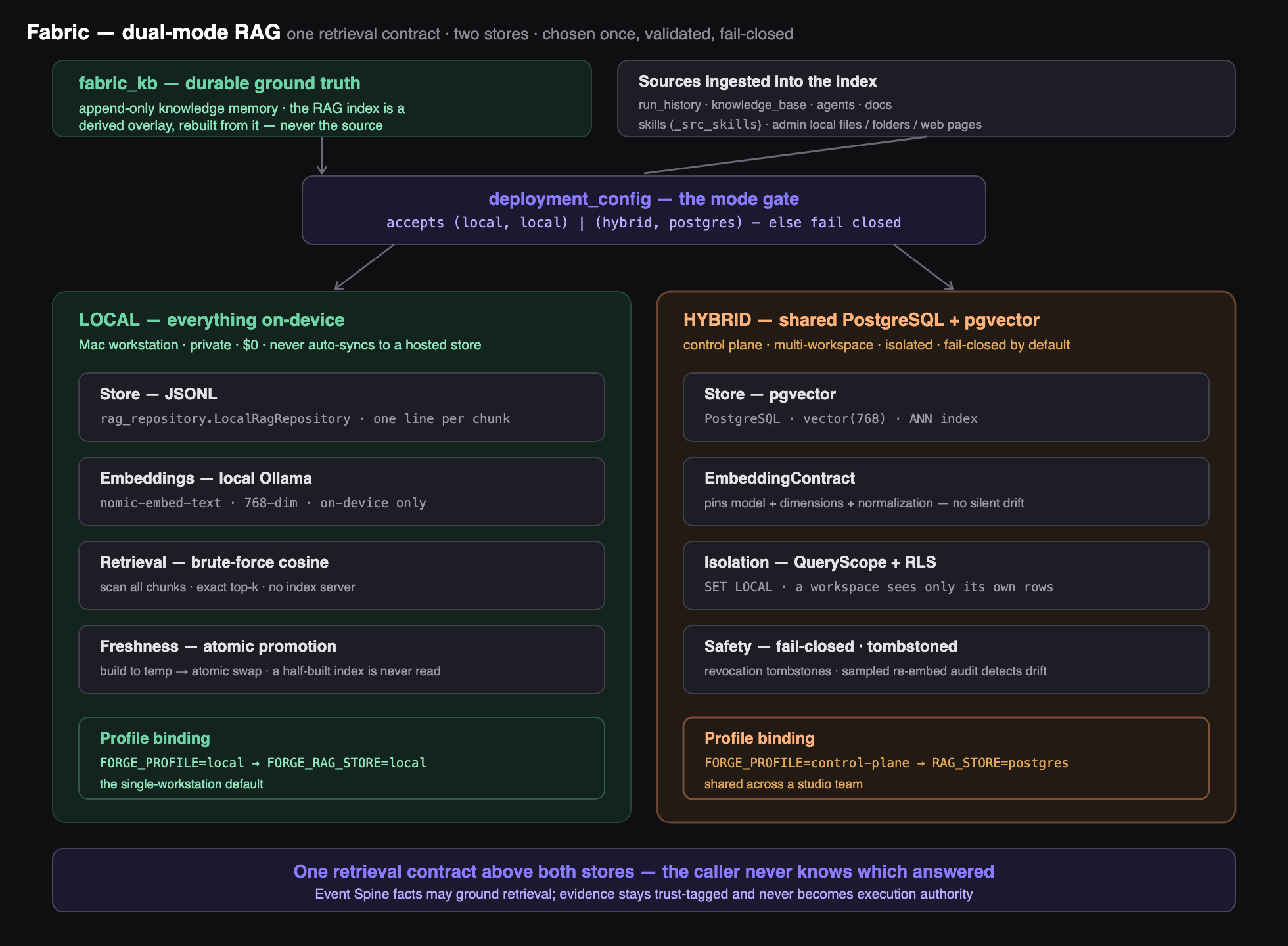
Context — the read-only Context Envelope composes World State, task/plan outcomes, retrieval evidence and provenance into one digest-bound decision input; it is not another store. Semantic — workspace-scoped RAG grounds reasoning in real production context, in one of two modes validated by deployment_config (fail-closed): local (JSONL + on-device embeddings) or hybrid (PostgreSQL + pgvector with an EmbeddingContract and row-level security). The knowledge base is ground truth; the index is a derived overlay. See ADR-0001.
Structural — the Code Intelligence Engine (ADR-0003) adds a code graph: impacted symbols, call chain and blast radius answer what a change touches. It runs structural-first and LLM-free to bound the search space, then scopes RAG to the blast radius — fewer, better chunks (fewer tokens, better fixes). Graphify is the first provider behind a swappable seam; a structural re-ranker fuses graph proximity with embedding recall. In hybrid mode the raw index never leaves the authenticated worker — only trust-tagged evidence crosses to the control plane.
Boundary: structural findings enter as derived evidence and retrieved chunks as untrusted reference — both ground reasoning but neither authorises, and neither is ever a deterministic gate; missing evidence stays missing. Reconciliation is canonical-to-derived only.
Context assembly, reasoning, tool execution and runtime events — the engine that turns a plan into observable work.
Boundary: no product-UI responsibilities live here.
Pure, auditable routing, evidence-derived confidence, preconditions, roles, World State and exact outcome-bound replanning.
Boundary: confidence never overrides a hard validation, policy or permission failure; unknown completion requires reconciliation rather than automatic retry.
Eleven integrations, each behind a shared resilience wrapper: Perforce, Jira, Confluence, GitHub (GHE) → S3, Photoshop, Unity (live MCP bridge), Google Sheets, Bugsnag (SmartBear MCP), Datadog, Slack, plus future MCP endpoints.
Boundary: irreversible work is never retried blindly; a failed source stops the run.
Four runtimes (generic · unity · offer · data), stage dispatch, queue, streaming and worker execution.
Boundary: a capability runs only where an executor supports its mode and runtime.
The JSON contract — stages, grounding, policies, validators, gates — that is the single source of truth.
Boundary: behavior is read/written only through validated JSON.
The HTTP router, NDJSON run streams, workspaces and the security boundary (origin/host/CSRF, tokens, roles, audit).
Boundary: unknown users, roles and action classes fail closed.
Visual authoring, Pipeline, Mission Control, Weave and explainability — the human control plane.
Boundary: presents and composes; never executes tools directly.
Harness certification, approvals, telemetry, health, run journal, post-mortems and the Character definition-of-done — cross-cutting every layer.
Boundary: a readiness score explains; hard gates and human sign-off remain binding.
Cross-cutting
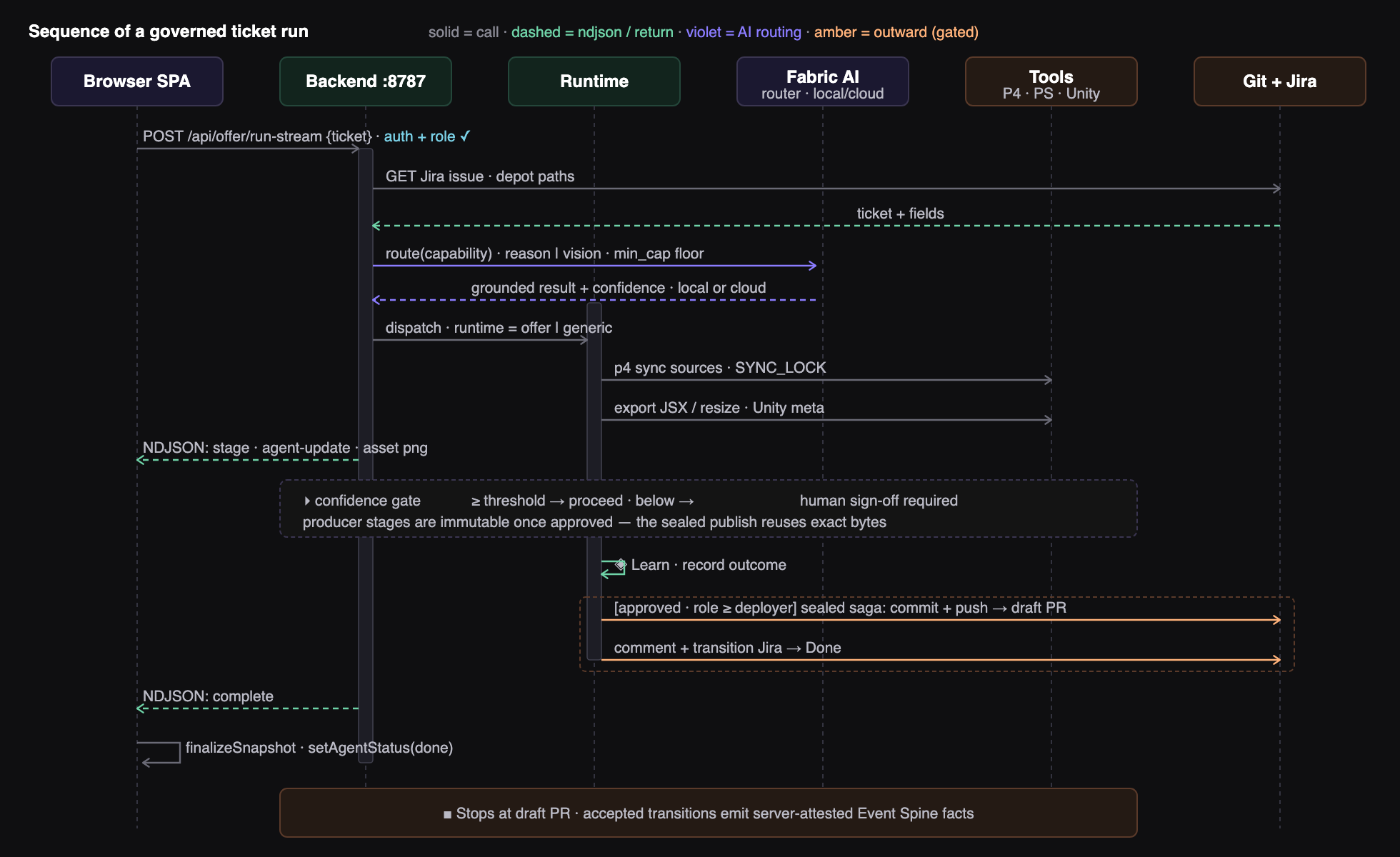
Between the plan and any outward effect. Deployer-level approval gates commit/push, S3, Content Bundles and Jira transitions.
Studio compiles the graph to agent JSON; the runtime reads that JSON and dispatches stages; run events stream back to the Studio canvas live.
Fabric authorities emit server-attested, workspace-scoped facts to the Canonical Fabric Event Spine. Its signed, hash-chained bus feeds Operation Rooms, Search & RAG, audit and the live UI as read-only projections; none can execute or approve work.
Connectors fail honestly; the security layer classifies every request; unresolved values and unsupported executors stop the run.
Commissioned agents export as checksum-sealed forge.agent-package.v1 bundles — portable workflow graph, profile metadata and permitted local skills, with credential-shaped fields stripped and traversal/oversized archives rejected. Preview is a bounded read; installation is a separate admin-gated action that never grants credentials, tool access, production routing or commissioning authority.
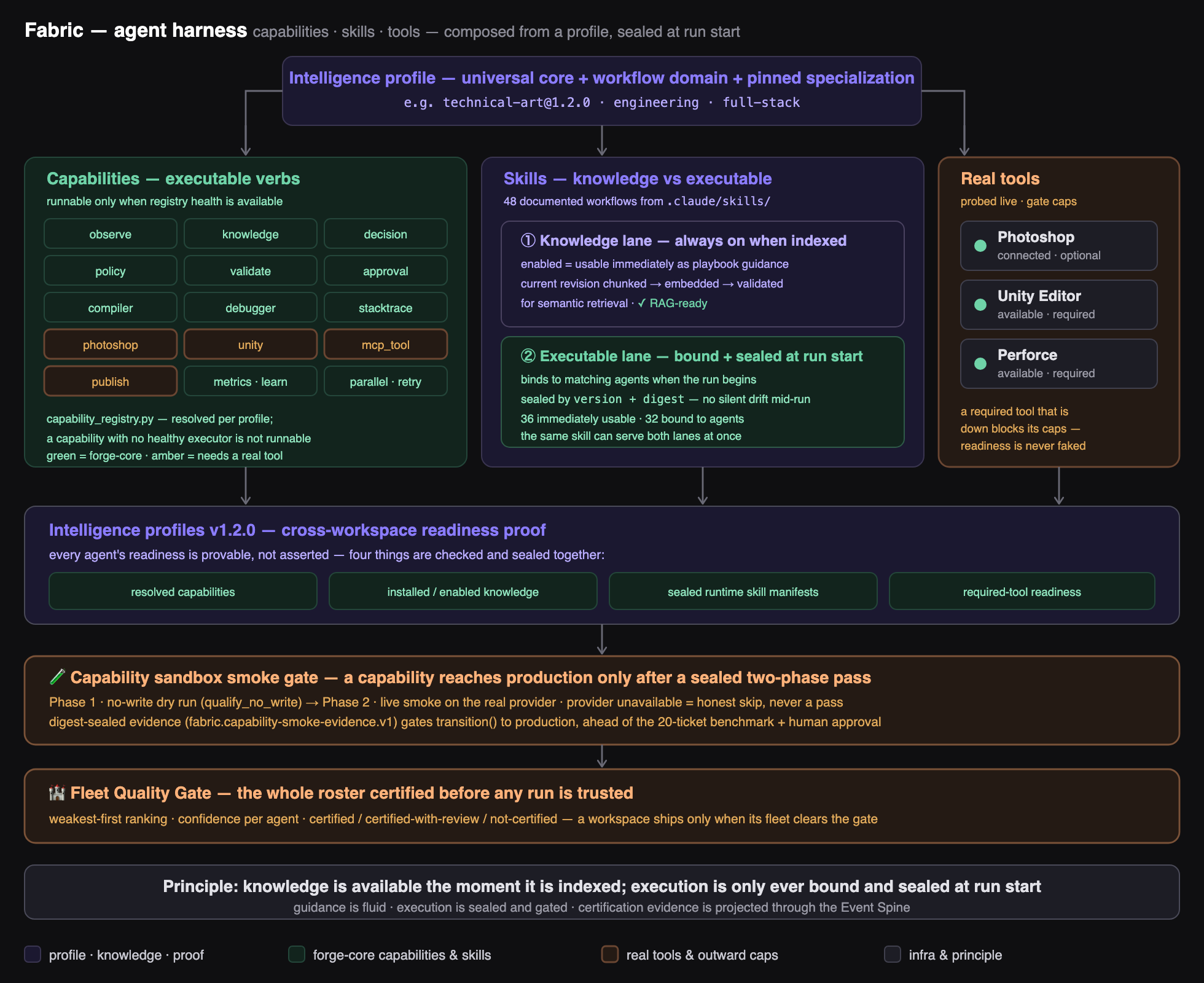
Before a capability can be promoted to production, capability_sandbox qualifies it one at a time: Phase 1 is a no-write dry run (qualify_no_write) over a minimal manifest-derived Skill Graph; Phase 2 is a live smoke against the real provider through an injected runner, with an honest skip — never a pass — when the provider is unavailable. Evidence is sealed and digest-bound (fabric.capability-smoke-evidence.v1); EVERY production promotion requires it — capability_builder.transition(…, "production") consults the gate as a mandatory additional condition, evaluated after the 20-ticket benchmark and human approval so it never short-circuits them, binding the evidence to the exact candidate and graph digest. The legacy physical_toolsmith.promote_production path threads the pilot's sealed smoke evidence through the same gate. Additive and fail-closed: missing, stale, failed, unverifiable or mis-bound smoke denies the promotion, and it never relaxes an existing one.
Event architecture
Every governed command reaches an execution authority through the Fabric Gateway and policy boundary. The resulting facts converge on the canonical Fabric Event Bus, which projects the same signed evidence into operation rooms, retrieval, audit timelines and the live UI without granting those read models execution authority.
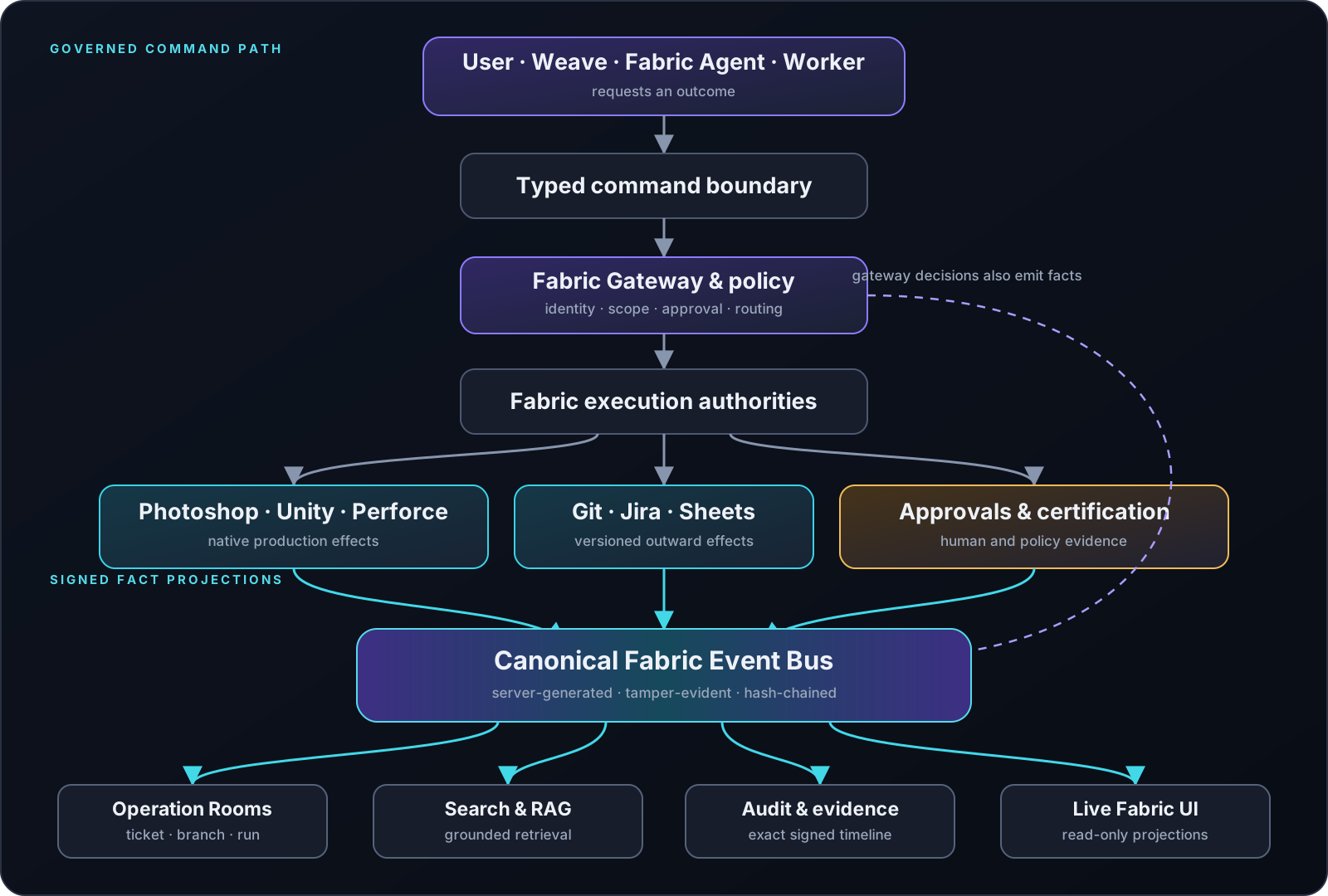
Operation Rooms reports the current process delivery state separately from retained projection gaps. A healthy publisher therefore stays green even when an older read-model delivery still needs operator review.
A projection-gap acknowledgement preserves the original dead-letter record and appends a signed, workspace-scoped operator fact. It does not retry a connector, resume a run, approve work, publish an agent or alter execution state.
Canonical events are server-generated and hash-chained. Gap acknowledgements name their original occurrence, actor, workspace and reason so audit can distinguish a repaired projection from a repeated side effect.
Idempotency reduces duplicate effects only where an adapter can reconcile external state. Unknown-completion cases remain stopped until the external system is checked and a new governed action is explicitly authorized.
Production intelligence
A workspace- and game-scoped read-only projection that connects tickets, Perforce sources, Unity assets, workflows, runs, artifacts, builds, incidents and owners into one governed graph. It federates existing authorities — Graphify stays the AST graph, workflow DAGs stay the executable definitions, and the Event Spine stays the authoritative execution record — and answers only bounded, typed questions, never free-form model-generated queries.
Graphify stays the AST graph, workflow DAGs stay executable definitions, and the Event Spine stays the authoritative execution record. The graph is a projection over those authorities — with revision and provenance on every fact.
Every fact carries an authoritative, derived or hypothesis trust class. Retrieval is trust-labelled, so grounding never silently promotes a guess to fact.
Only typed operations run — ticket implementation, asset consumers, artifact origin, blast radius, related incidents, build contents, ownership — never unrestricted model-generated graph queries.
as_of reads, graph diffs, signed-event replay, tombstones, identity review, retention, online backup and isolated recovery drills — history is inspectable and reproducible.
Decision record: ADR-0011 · Governed Production Knowledge Graph & GraphRAG.
Diagrams
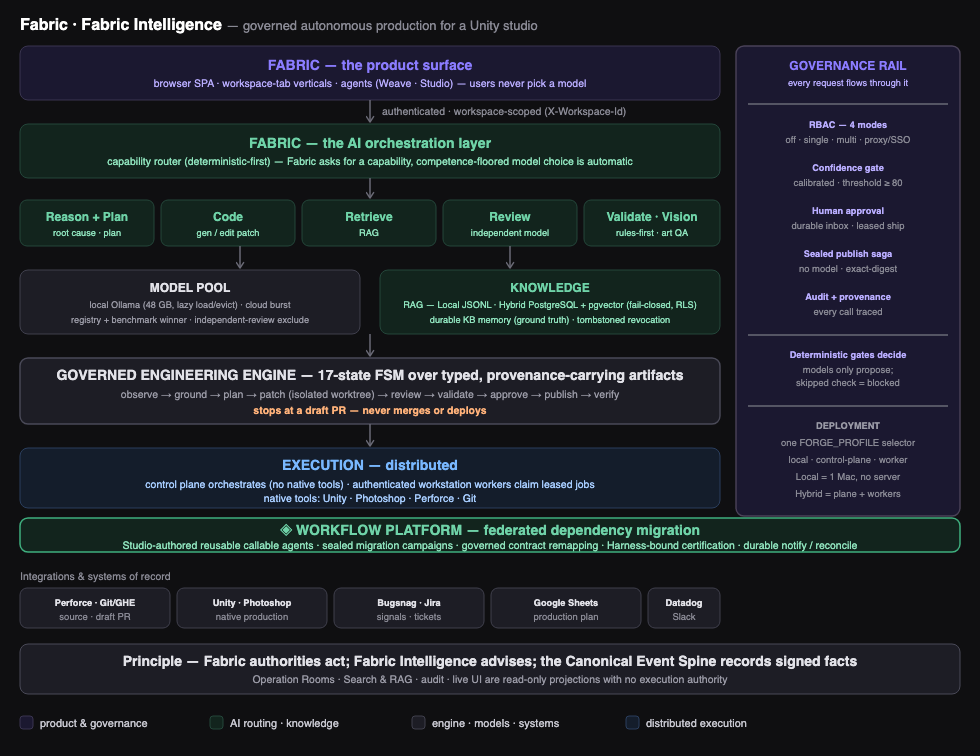
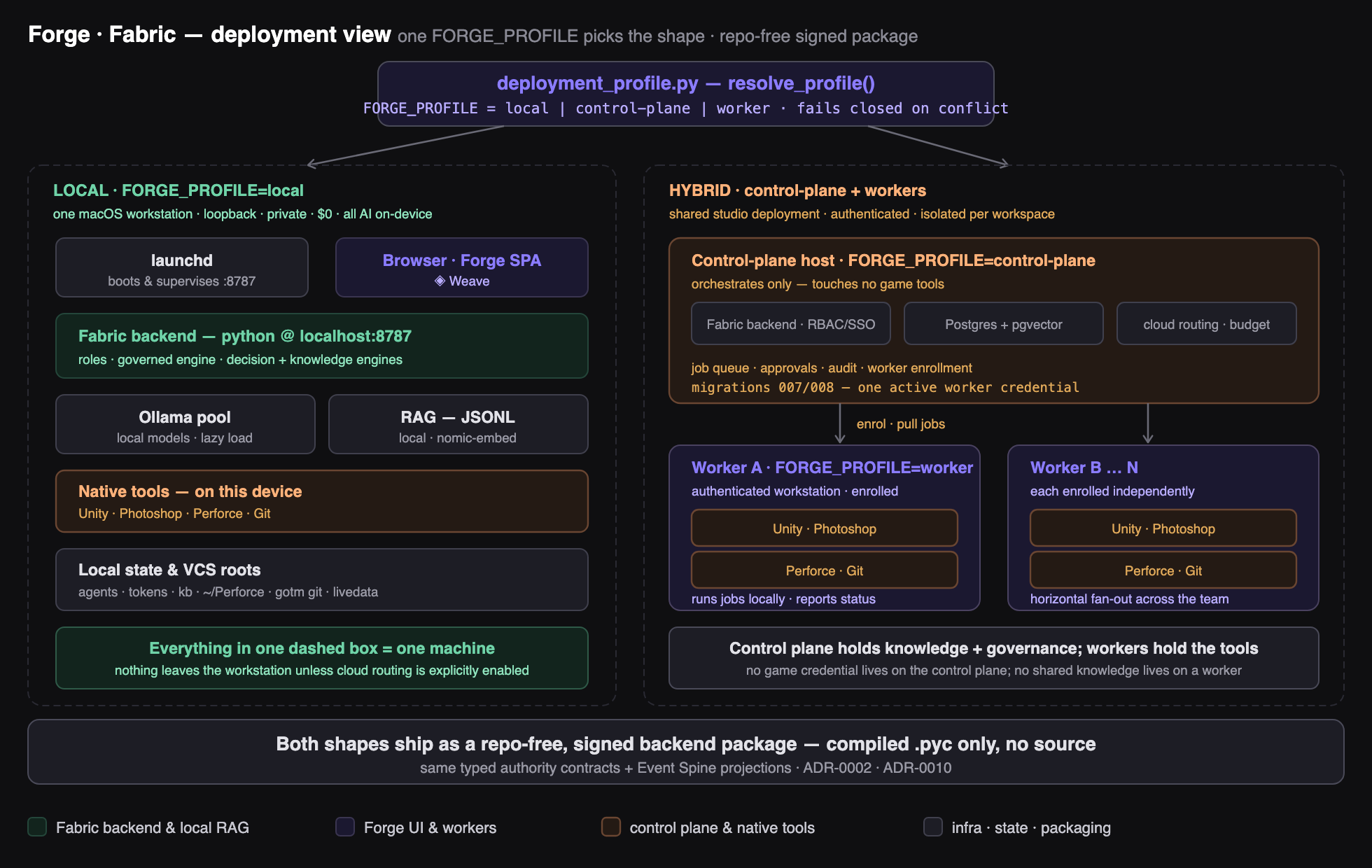
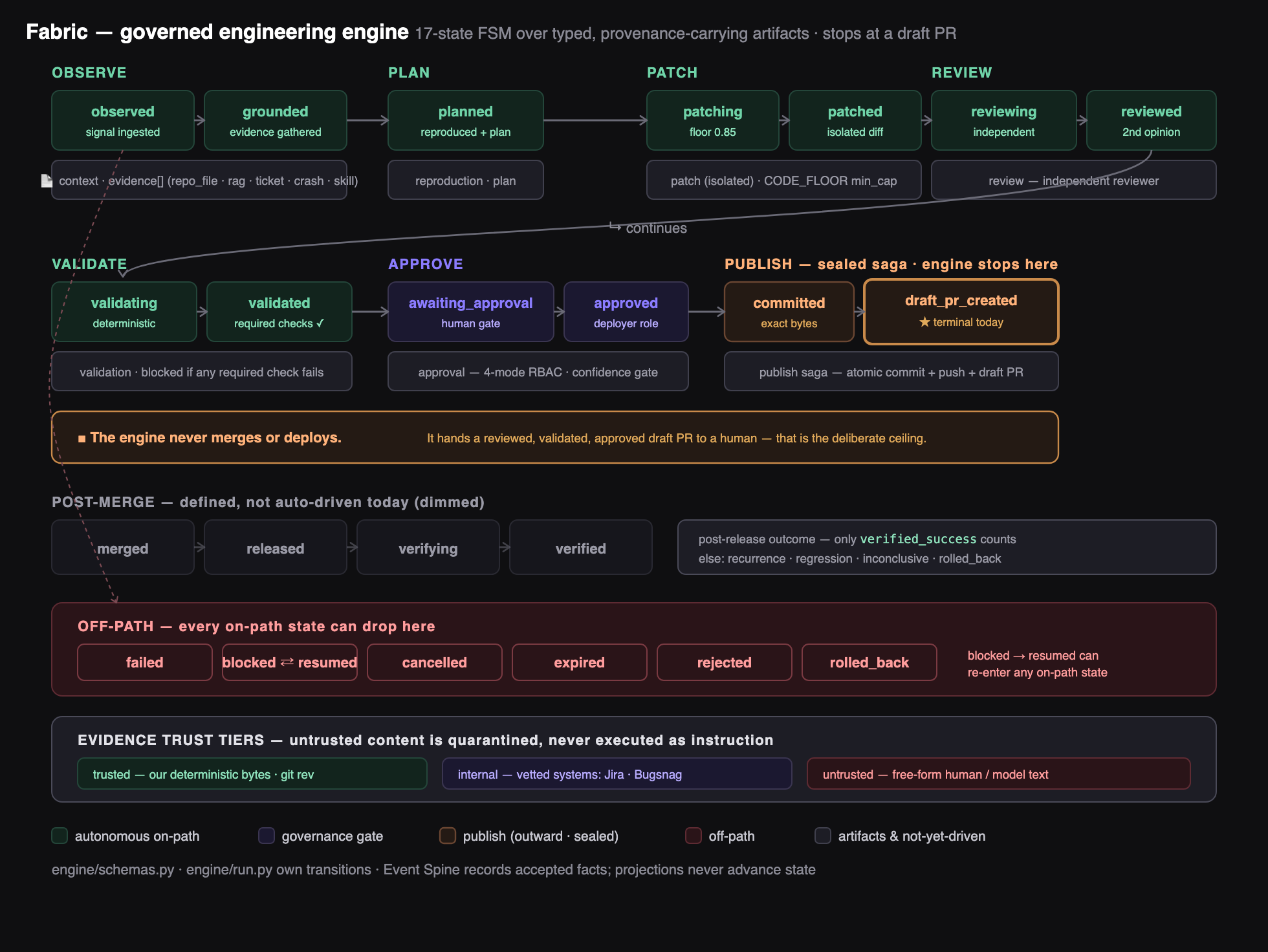
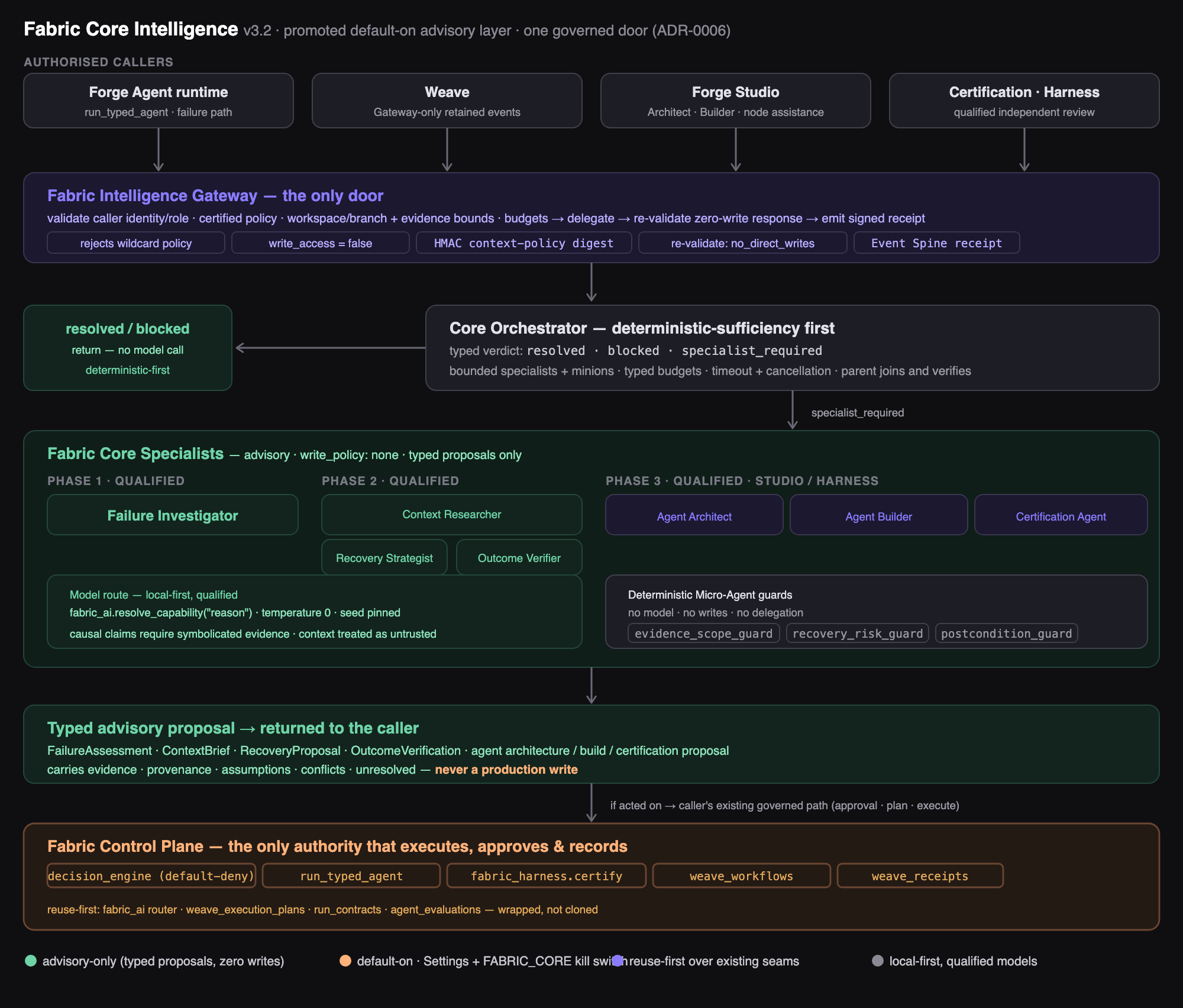
Twelve diagrams, synchronized to the v3.2 architecture. Start with the one-pager, then drill into the layered stack, governed ticket run, deployment shapes, AI operating system, model routing, dual-mode RAG, governed-engine state machine, agent harness, enterprise planes, promoted Core Intelligence and the Canonical Fabric Event Spine. The numbered set is available as SVG, PNG and PDF; the Event Spine uses a responsive SVG source. Select any thumbnail to inspect it in the wiki viewer, or open the complete architecture gallery.
Deployment
Fabric deploys in one of two shapes, selected by a single FORGE_PROFILE environment variable resolved by deployment_profile.py, which derives the legacy flags and fails closed on any conflict. Both ship as a repo-free, signed .pyc package — a studio stands Fabric up without cloning the repository. See ADR-0002 and the deployment-view diagram.
FORGE_PROFILE=localOne macOS workstation: the launchd-supervised backend on loopback :8787, the browser, a local Ollama pool, JSONL RAG, and the native tools (Unity, Photoshop, Perforce, Git) — all on-device, private, $0. The distribution now ships as separate, digest-verified server and optimized client packages that are joined locally by FORGE_FRONTEND_DIR. No remote worker is required. Local package setup →
A control-plane host runs the shared backend with RBAC/SSO, PostgreSQL + pgvector knowledge, and cloud routing — but touches no game tools. Authenticated workstation workers (FORGE_PROFILE=worker) run Unity, Photoshop, Perforce and Git locally and enrol with a single active credential. The control plane holds knowledge and governance; the workers hold the tools.
Decision records
The load-bearing choices are captured as ADRs in docs/architecture, each with context, the decision, and its constraints.
Local JSONL vs hybrid PostgreSQL + pgvector; EmbeddingContract, QueryScope, row-level security, fail-closed. Accepted.
One FORGE_PROFILE (local / control-plane / worker); repo-free signed backend; control-plane + worker split. Proposed — implemented, pending SRE + security sign-off.
Structural-first intelligence behind an evidence contract (impacted symbols, call chain, blast radius); Graphify as the first provider — derived evidence, never a gate. Accepted and operational — used by bug fixing, AI Draft, planning, review, validation, Weave architecture/impact answers, root-cause analysis and release-risk analysis. Revision-seeded incremental refresh, telemetry, bounded graph views, versioned evaluations and explicit human feedback improve it without exposing the raw local graph.
Reasoning, recovery, agent fabrication and verification promoted behind one typed, default-deny Intelligence Gateway; Core Orchestrator selects at most one qualified specialist; advisory-only, with a Settings kill switch and emergency override. Accepted and promoted to default-on.
A canonical, server-attested, hash-chained fact bus (forge.event.v1) with idempotent admission; read-only Operation Rooms, RAG, audit and live-UI projections that cannot execute or approve. Accepted for workstation milestone 1.
A rebuildable, workspace-scoped read projection that federates Graphify, workflow DAGs and the Event Spine; typed entities with trust classes; bounded typed operations and hybrid GraphRAG; SQLite/FTS5 with a PostgreSQL adapter. Accepted — local projection & hybrid retrieval implemented.
Reference
The suite packages a private runtime, matching Executor/client resources and a separate Studio bundle. Manifest verification covers support files as well as application code. Native signing, Apple notarization, final-archive checksum and the recorded release gate are distribution evidence in addition to package verification.
Reinstall/upgrade stages both apps and preserves configuration, credentials, agents, memory and history. Runtime writes must stay outside signed packages. The current 2026.9.84 repository candidate binds both apps to source revision 9095b65 and records signed release-mode artifacts, Accepted notarization and a checksum-bound archive. Broad distribution approval remains separate.
Hosted wiki updates do not change an already-installed offline help snapshot or install runtime fixes. A new signed installer is required to redistribute packaged content. Distribution guide.
Reference
| Concern | Repository source |
|---|---|
| Settings and paths | dashboard/index.html, dashboard/assets/forge_settings_views.js, dashboard/path_settings.py |
| Connectors and credentials | dashboard/connector_registry.py, dashboard/google_oauth.py, provider adapters |
| Setup transfer | dashboard/assets/forge_setup_transfer.js and backend setup routes |
| Studio package handoff | studio/core.py, studio/package_export.py, studio/executor_bridge.py |
| Knowledge and memory | dashboard/fabric_rag.py, rag_query.py, fabric_memory.py, skills_registry.py |
| Code Intelligence | dashboard/code_intel/graphify_provider.py and Code Intelligence services |
| Production Graph | dashboard/production_graph*.py and graph_runtime_intelligence.py |
| Publication | livedata_branch_policy.py, offer_publish.py and governed publishers |
| Distribution | tools/build_backend_package.py, suite builder, packages/local and packages/studio |
| Release truth | local-distribution/RELEASE-NOTES.md and the matching artifact verification records |


