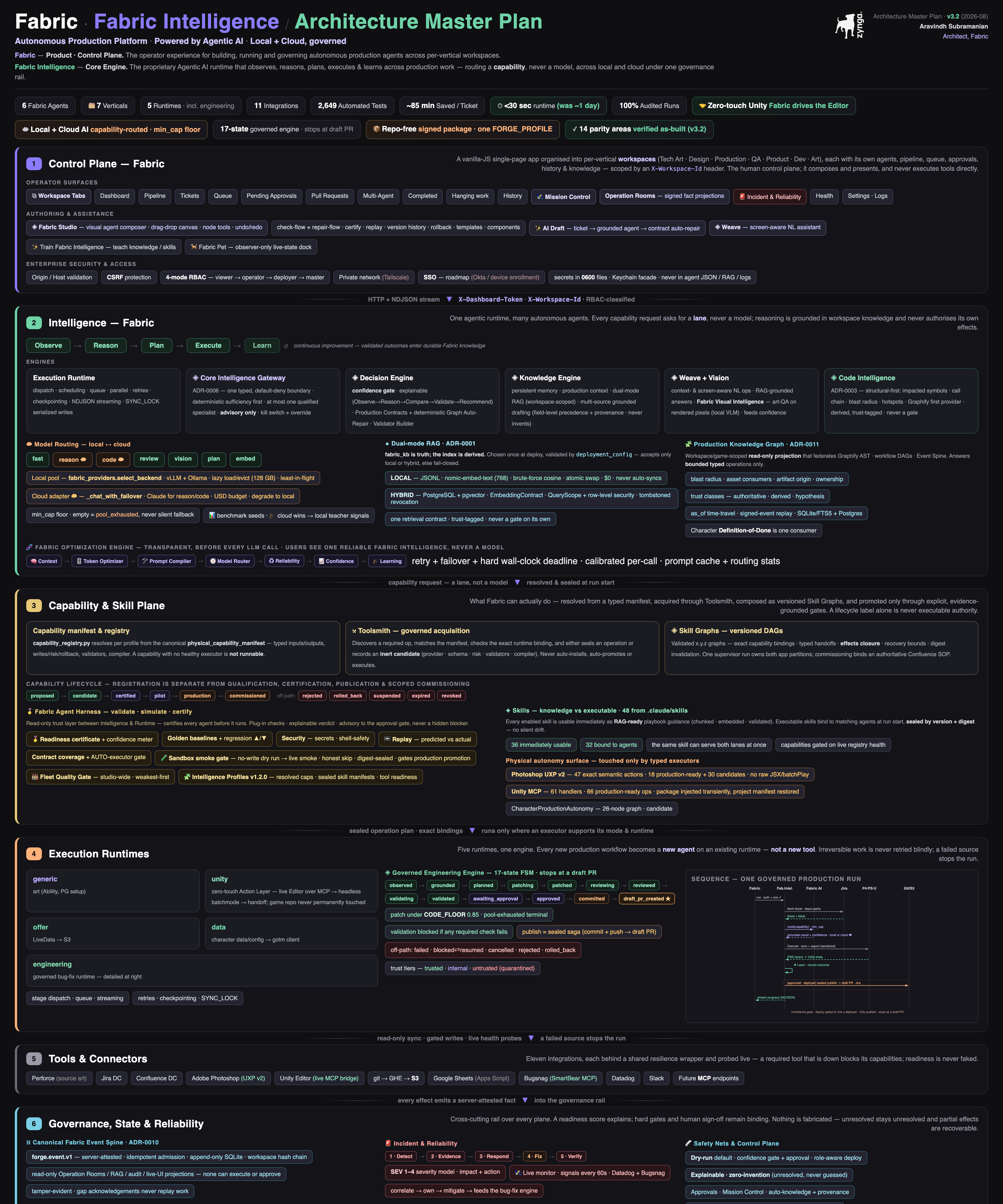
Fabric turns a production request — a Jira ticket, a character, an offer — into grounded, validated, auditable work, run by autonomous agents that a human approves before anything ships. This page assumes no prior knowledge of agents, pipelines, RAG or AI systems.
Game production is full of repetitive, multi-tool, error-prone work: pull source art from Perforce, run Photoshop actions, wire sprites and metadata in Unity, set up character data, package an offer, validate, commit, update Jira. Done by hand it is slow, inconsistent, and easy to get subtly wrong.
Fabric does that work autonomously — and provably.
An agent executes the real tools, grounds every value in a real source, validates the result, and holds for a human sign-off before any outward effect. You get the speed of automation with the accountability of a reviewed change.
◆
Fabric suite
The suite has two independent apps: Fabric Studio builds and signs agent packages; Fabric validates imports, then runs, governs and audits admitted work. Valid independently certified imports with satisfied dependencies can be ready for manual runs.
◈
Fabric Intelligence
The intelligence core beneath the suite — it grounds, reasons, decides, executes through real tools, and records everything.
▣
Agents
JSON-defined production workflows. New work becomes a new agent on the same engine — not a new tool.
2
Choose your path
Two ways in
The wiki is organised for two audiences. Pick the track that matches why you're here — the left sidebar mirrors these two groups.
Not sure? Leadership and newcomers should read What Fabric is first — it maps the whole platform and its boundaries in a few minutes.
3
Positioning
How Fabric differs
Grounded, not hard-coded
A script encodes one path and breaks on the next edge case. A Fabric agent grounds each value in a live source and reports what it could not resolve instead of guessing.
Governed, not fire-and-forget
Scripts run and hope. Fabric previews reads/writes, validates, and requires a human sign-off before outward effects — with a full audit trail.
Reasoning, not just triggers
Rule-based automation moves data between apps. Fabric reasons over production context (RAG + knowledge) to decide what to do, then executes real native-tool work.
One engine, many domains
Each new production vertical is a new agent on the same runtime — Tech Art contains the established agent families; current commissioning is installation-specific; Design and Dev (the governed bug-fix engine) are in development; Production, QA, Product and Art are scaffolded next (7 verticals in all).
Deterministic first
A chat assistant answers; Fabric acts. Deterministic logic runs first; AI is used only where it adds value, always grounded, and it never decides whether a production gate passed.
AI can’t mutate production
Weave is read-only. Models are a replaceable capability behind a contract — you request a lane (fast/reason/code/…), routed to a local model or, for reason/code, a cloud specialist under budget; swap the model and nothing above it changes.
4
Together
How Fabric and Fabric Intelligence work together
You describe intent in Fabric. Fabric Intelligence observes and grounds it, reasons and plans, executes through the right runtime and connectors, and streams progress back live. Governance (validation, confidence, approval) sits between the plan and any outward effect; resilience (journal, health, post-mortems) records everything so a crash never hides partial work.
5
Guided tour
Your first five minutes
1
Open Fabric and pick a workspace
Each production vertical (Tech Art, Design, …) has its own agents, history, queue and knowledge. Integrations (Jira, Perforce, Unity, Git) are shared.
2
Check health
The Connections view shows Jira, Perforce, Unity, Photoshop, Git and AI status. Green means ready.
3
Run a ticket in preview
Preview grounds the ticket and shows the plan, reads and proposed writes — no live mutation.
4
Read the evidence
Every value carries its source; confidence and validators explain readiness. Unresolved values stay explicit.
5
Approve, teach, then publish
Review the exact evidence. Accept, deny/request changes, or ignore neutrally; then prepare a separate sealed publication approval for outward effects such as commit/push, Sheets/S3 and Jira transitions.
6
Vocabulary
Key concepts & glossary
Workspace
A production vertical with isolated agents, history, queue, knowledge and model pins; integrations stay shared.
Agent
A JSON-defined production workflow. Its runtime selects the engine; dynamic_subagents only controls fan-out.
Runtime
One of five execution engines: generic (art), unity (zero-touch Action Layer), offer (LiveData → S3), data (character setup), engineering (governed bug-fix).
Capability / Stage
A unit of work such as Observe, Transform, Validate, Approval or Publish. A stage is a capability inside an agent definition.
Grounding & provenance
Binding a value to a real source (ticket, sheet, Perforce, wiki) and recording where it came from — never invented.
Confidence & approval
Confidence summarizes evidence; it never overrides a hard validation or policy failure. Outward effects need a human sign-off.
Harness
The read-only trust layer that validates, simulates and certifies an agent before it runs.
Definition of done
A deterministic, read-only check of whether a character’s required artifacts actually exist — evidence owns the verdict.
↗
Get running
Install and configure the local suite
1
Install the current suite
Open Fabric Installer.app, then Fabric.app from ~/Applications. Check Settings → General → About Fabric.
2
Follow the setup guide
Step-by-step setup covers paths, setup import, every required connector, signed agents and the first governed run.
3
Check this Mac’s readiness
Saved credentials and installed tools do not prove a live bridge or repository is ready. Test required services before running.